








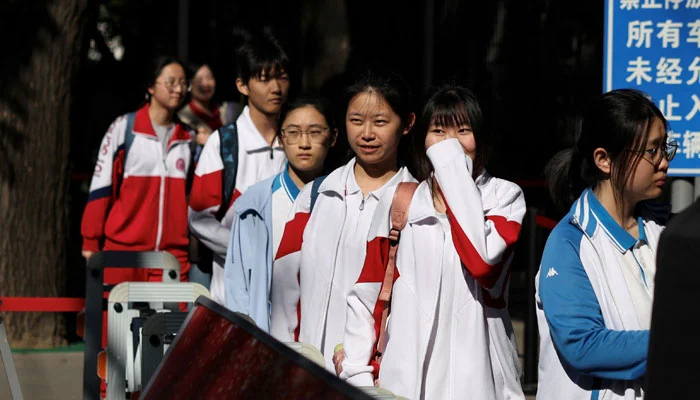
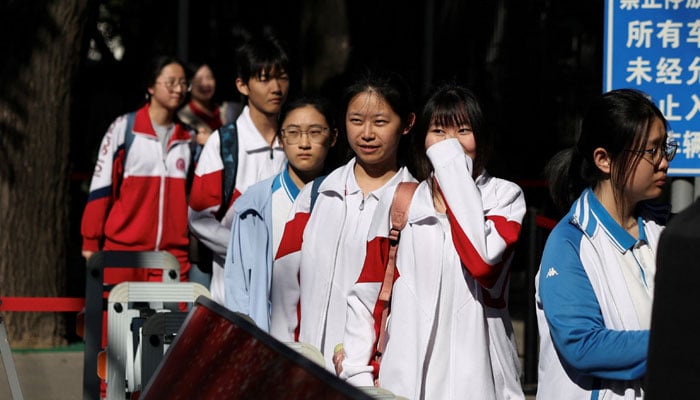
Hundreds of young Chinese students clutching pens and their IDs shuffled into a testing centre in blue-skied Beijing on Sunday, swarmed by parents, joining millions sitting for the national high-stakes university entrance exam.
Around 12.9 million students nationwide registered for this year’s “gaokao”, according to the Ministry of Education, which for most is the sole determining factor in admission to a Chinese university.
The multi-day exam, which began Sunday, drills test-takers on subjects including Chinese, mathematics, English, science and the humanities — with the tallied scores to be released later this month.
“It’s my first time, so I’m a bit anxious,” said student Zhang Xinnan moments before entering the exam hall.
The spectacled Beijinger admitted he was nervous for the essay portion of the Chinese test, as he said he thought the prompts had become harder to respond to.
But, wearing his school uniform, the 18-year-old told AFP that despite the jitters he thought he would do well, having spent the last year drilling practice questions.
“The things we needed to master have been mastered,” said Zhang, who hopes to work with new energy vehicles.
“Just go in with self-confidence; you’ll be solid.”
Some mothers and fathers clustered outside the exam halls dressed in red, a symbol of good fortune in Chinese culture.
Dozens of police and security guards milled about as parents stood beside the line of students waiting to enter the exam hall, hoping to film their children walking inside.
Shifting attitudes
High-level education has expanded rapidly in China in recent decades as an economic boom pushed up living standards — as well as parental expectations for their children’s careers.
Yet the job market that fresh graduates enter is no longer as rosy as it once was, with high youth unemployment a significant concern.
Roughly one in six Chinese between the ages of 16 and 24, excluding students, are jobless, according to official data.
Attitudes toward the test are changing, with students and parents more and more unwilling to trade physical and mental health for high test scores.
“I’m pretty free range,” said mother Deng Ju, standing across from the exam hall holding a stack of practice books for her daughter, revising last minute with her friend nearby.
“Just perform normally; that’s enough,” said Deng, 53. “I care more about physical health; the test is just a formality.”
For Deng, whose daughter isn’t aiming for a “name school” such as the elite Tsinghua or Peking University in the capital, doing away with the gaokao would be ideal.
“No more gaokao. Let’s not gaokao anymore,” she told AFP. “But that’s impossible,” she said, smiling.
For many Beijing students, the gaokao was still a step toward achieving their dream.
“I hope I can go to my ideal university,” said student Zhang.
His friends also cared about the exam, he said.
“But if we can calm down, we should be able to get to a stable mentality,” said Zhang.
“Mentality is the most important when it comes to the gaokao.”